


Most business owners think about marketing one piece at a time.
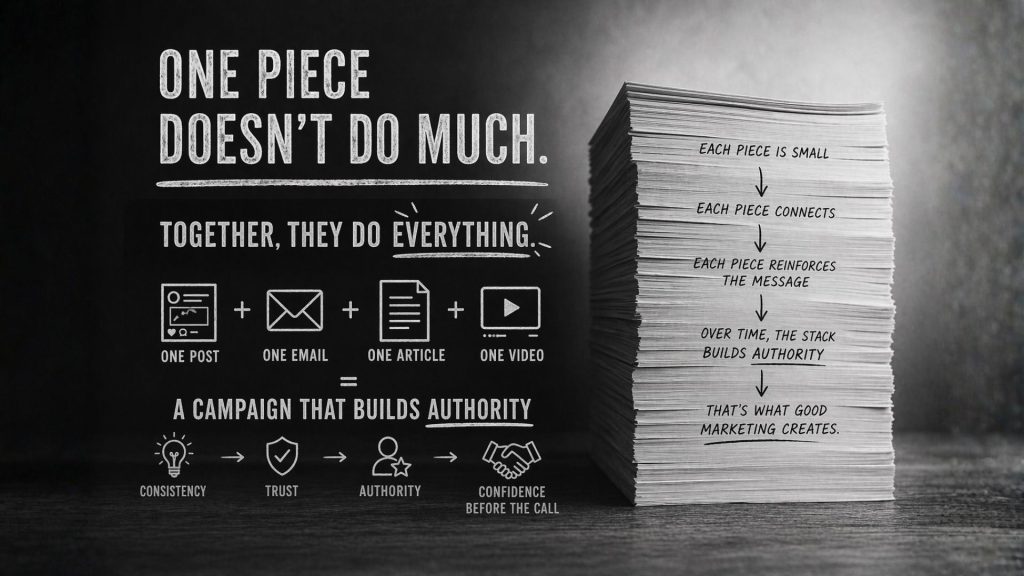
One post. One email. One article. One video.
Each piece feels small, and because it feels small, it’s easy to convince yourself it doesn’t matter. It’s easy to skip the newsletter, delay writing the article, or decide that posting this week isn’t a priority.
Individually, none of those things feels significant.
But marketing doesn’t work one piece at a time. Marketing works when those pieces connect and reinforce each other over time.
When your emails support your articles, your articles support your offers, and your posts reinforce the same message, your marketing becomes a coordinated effort. That coordination is what turns marketing into a campaign instead of a collection of posts.
Every piece of content you create is like a sheet of paper going into a stack.
One sheet of paper weighs nothing. A full stack is heavy.
Over time, that stack becomes proof of your experience. It becomes evidence of your thinking and a visible record of your thought leadership and the problems you solve.
When buyers encounter your business, they aren’t evaluating one post or one email. They’re seeing the stack.
They see your experience, your consistency, and your authority.
After following you on social media or receiving a few newsletters, they begin to feel certain about you before a sales conversation ever happens.
That certainty is what good marketing creates.
Strategic marketing turns isolated posts into a body of work. Over time, that body of work becomes your authority.
One of the most important shifts business owners can make is moving from thinking about posts to thinking about campaigns.
To help you turn individual pieces into a coordinated campaign, I’ve created a prompt you can use with AI:
Campaign Planning Prompt
Act as a marketing strategist.
My business: [describe what you do]
My target audience: [describe your ideal customer]
My main offer: [product or service]
My campaign goal: [sales, leads, event registrations, etc.]
My timeline: [example: next 90 days]
Using this information, help me design a strategic marketing campaign with a clear goal, message, and timeframe.
Identify a strong campaign theme and the key ideas that should be repeated throughout the campaign to make the message memorable.
Recommend a coordinated set of content ideas that work together across email, social media, articles, or video so each piece supports the overall strategy.
Suggest a realistic timeline and cadence that builds consistency and momentum. Keep the plan practical and focused on what will actually help me attract and convert the right clients.
Once you’ve planned your campaign, the real work begins. Follow the campaign guidance, start writing posts, recording podcasts, and sending newsletters to your clients to add sheets of paper to your stack of thought leadership.
Over time, clear campaigns and consistent effort will turn your marketing into one of your most valuable business assets.
A word of caution: AI is great at helping you plan out the campaign but don’t let it steal your voice, or your thinking. That is where the real thought leadership originates.




 A LIVE 5-MONTH COHORT WITH LISA LARTER · STARTS AUG 4, 2026